A specialized database for CO2 capture adsorbent materials, independently developed by the Resource Utilization and Environmental Protection Technology Group at the Department of Energy and Power Engineering, Tsinghua University, has been officially launched and is now freely accessible to researchers worldwide (http://www.thuco2capture.com).
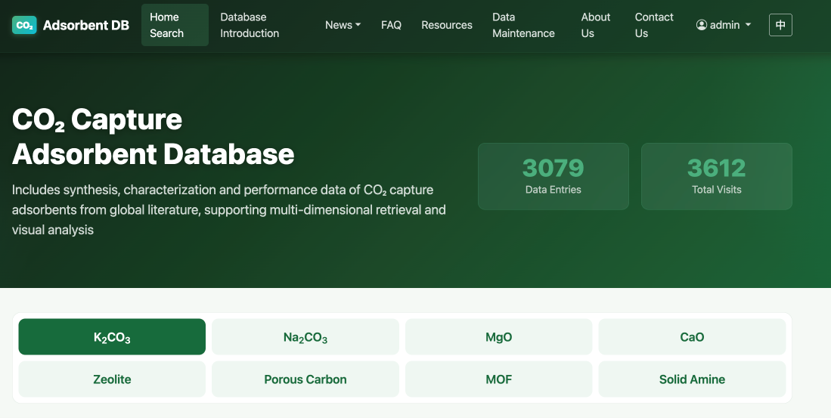
Homepage of the CO2 Capture Adsorbent Database
The database focuses on solid adsorbent materials for CO2 capture and integrates publicly available data from global scientific literature with experimentally measured data generated by the group and its collaborators. By combining data retrieval, multi-dimensional screening, data visualization and community-based data contribution, the platform aims to accelerate the transition of carbon capture materials research from experience-driven exploration to data-driven discovery, while serving as a comprehensive database for CO2 adsorbent materials.
Solid adsorbents are among the key technologies for CO2 capture, with applications ranging from carbon removal from power-plant flue gases and industrial emissions to direct air capture (DAC). However, experimental data on these materials remain scattered across the literature, often with inconsistent definitions of variables, testing conditions, measurement units and performance evaluation methods. This fragmentation creates significant challenges for researchers seeking to identify structure–property relationships and develop high-performance adsorbents with low regeneration energy requirements.
Leveraging the group’s long-term expertise in carbon capture materials and data standardization, the platform integrates the entire workflow from literature data collection, cleaning and validation to structured database construction and online system development. Currently, the database contains more than 3,000 records of CO2 adsorbent materials, covering eight major categories, including potassium carbonate, sodium carbonate, magnesium oxide, calcium oxide, molecular sieves, porous carbons, metal–organic frameworks (MOFs) and solid amines. The database systematically organizes information on synthesis methods, precursors, physicochemical properties, chemical compositions, adsorption temperatures, CO2 concentrations and adsorption performance, while preserving original literature sources to ensure data traceability.
Users can search for target materials and key parameters through basic filtering and advanced multi-field screening functions. The platform also provides visualization tools, such as scatter plots, enabling direct comparison of adsorption performance under different material compositions and experimental conditions. Each data point can be linked back to the corresponding record and original publication. In addition, users can submit new datasets or corrections by contacting the website administrators, which will be reviewed and incorporated into the platform to promote community-driven data sharing.
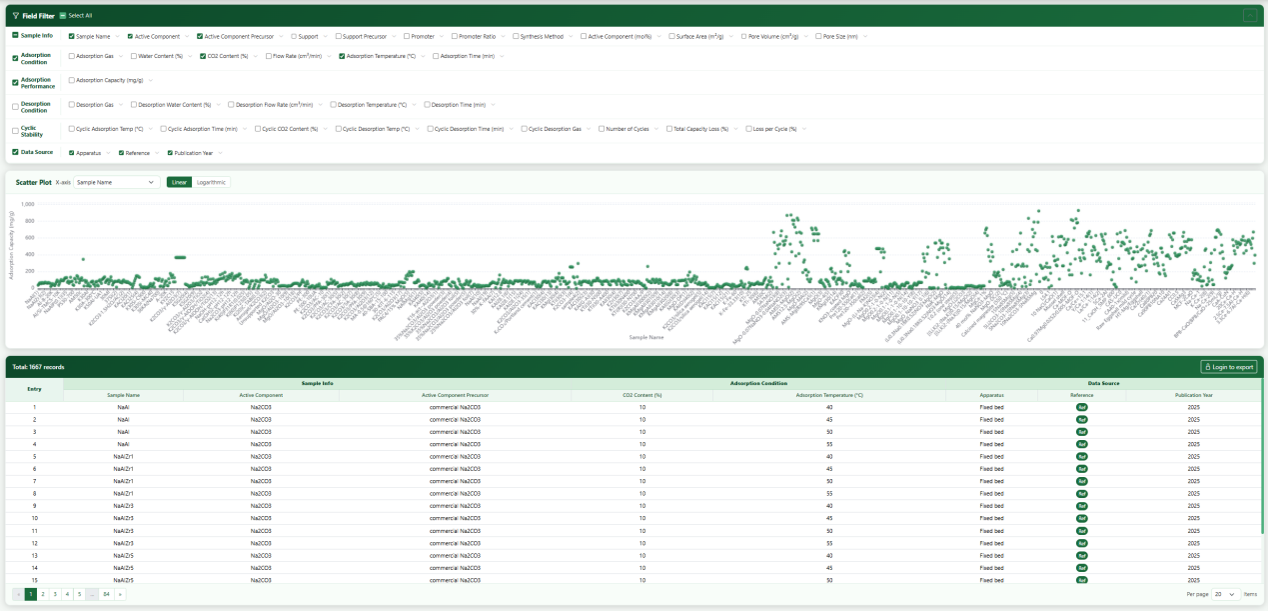 Data visualization interface
The group will continue expanding the database and improving data quality control. Future updates will introduce machine-learning-based performance prediction modules and explore deeper integration with large language models (LLMs) to develop an intelligent evaluation system for CO2 solid adsorbent materials. Through natural language interaction, users will eventually be able to query material parameters and synthesis methods, predict CO2 adsorption performance, analyze structure–property relationships, and identify promising candidate materials for practical applications.